Alongside literary criticism, scholarly studies, media coverage and other traditional forms of reception, the twenty-first century has created another space in which books continue their lives — among readers on the Internet.
This section follows the digital reader reception of Milorad Pavić's works: ratings and reviews on international platforms, reader-created lists and rankings, discussions in online communities, recommendations, and independent digital projects inspired by Pavić's books.
A special place belongs to Dictionary of the Khazars. More than four decades after its first publication, new generations of readers are discovering it not only as a work of postmodernism, but also connecting it with contemporary concepts such as ergodic literature, nonlinear fiction, experimental literature and innovative book structure.
GOODREADS
Goodreads is one of the world's largest online platforms devoted to books and reading. Readers record what they have read or want to read, rate books from one to five stars, and write reviews.
Goodreads lists Milorad Pavić with 115 works.
PAVIĆ'S BOOKS ON GOODREADS
As of August 2026
The figures on Goodreads change continuously, and individual editions of the same work may display slightly different current totals. The table should therefore be understood as a snapshot rather than a permanent statistic.
Goodreads places Dictionary of the Khazars in the following categories:
Fiction · Fantasy · Historical Fiction · Magical Realism · Classics · Literature · Serbian Literature
Landscape Painted with Tea appears under Fiction · Magical Realism · Fantasy · Literature · Classics · Novels · Serbian Literature, while The Inner Side of the Wind is categorized as Fiction · Magical Realism · Classics · Novels · Serbian Literature · Literary Fiction · Romance.
For Last Love in Constantinople, the categories include Fiction · Magical Realism · Serbian Literature · Historical Fiction · Literature · Fantasy · Tarot — showing that readers and the platform itself also recognize the novel's distinctive structure based on the Tarot.
LISTOPIA
Listopia is a part of Goodreads where readers themselves create thematic book lists and vote for books.
These are not literary prizes or selections made by professional juries. The lists are created through reader votes, and their rankings change over time.
DICTIONARY OF THE KHAZARS ON LISTOPIA
In addition, Dictionary of the Khazars ranks #10 on Uniquely Structured Books, #44 on Anti-novel, #116 on A Postmodernist "Canon", #215 on Books about Books, and #319 on Best European Literature. On the list strangest written books ever, it ranks sixth.
Particularly noteworthy are its high positions on Ergodic Literature (#7), Best South Slavic Literature (#9) and Books with Innovative Book Design / Structure (#26). These rankings show that contemporary readers do not place Dictionary of the Khazars solely within a national or historical literary category, but recognize it precisely for the way it is constructed.
JONATHAN BLOW: PAVIĆ BETWEEN LITERATURE AND VIDEO GAMES
A particularly unusual trace of Pavić's digital reception can be found on the Goodreads Listopia list Jonathan Blow.
The list is devoted to books read or recommended by American programmer and video-game designer Jonathan Blow.
At the top of the list are:
#1 — House of Leaves — Mark Z. Danielewski
#2 — Dictionary of the Khazars — Milorad Pavić
#3 — Landscape Painted with Tea — Milorad Pavić
Thus, two Pavić novels are among the top three books. They are followed by works by Tom Phillips, Italo Calvino, Thomas Pynchon and other authors, as well as books on mathematics, programming and theory.
This list is particularly interesting in the context of digital reception. Here Pavić does not appear in the selection of a Slavist, literary historian or critic, but within the intellectual world of a video-game creator — a medium in which nonlinearity, choice of path, interaction, structure and active user participation are fundamental elements of the work.
What appeared to be a radical literary experiment when Pavić's novels were first published therefore communicates naturally today with digital forms of storytelling.
Reddit is a vast international network of discussion communities — subreddits — devoted to an enormous range of subjects and interests.
Unlike Goodreads, where ratings and individual reviews predominate, Reddit allows us to observe the conversation that develops around a book.
Dictionary of the Khazars appears in communities devoted to literature, fantasy, experimental fiction and "weird" literature. In January 2026, a reader posted a lengthy analysis of the novel on WeirdLit, describing it as a fascinating book whose layers are enjoyable to unravel, while attempting in detail to reconstruct its different narrative levels.
In April 2026, another reader wrote that they had picked up the book almost by chance and had come to love it, particularly emphasizing its poetic quality, strangeness and dreamlike imagery.
Dictionary of the Khazars also appears as a recommendation for readers looking for books similar to House of Leaves — precisely an audience interested in unusual forms and a different relationship between reader and text.
There is even a small but telling example from 2026: a Reddit user was trying to remember a book they had once read — an unusual "dictionary" by an Eastern European author, existing in two different versions. Another user immediately identified it as Dictionary of the Khazars, and the person who had asked confirmed that this was exactly the book they had been searching for.
DICTIONARY OF THE KHAZARS READING COMPANION
The most unusual new form of digital reception appeared in August 2026.
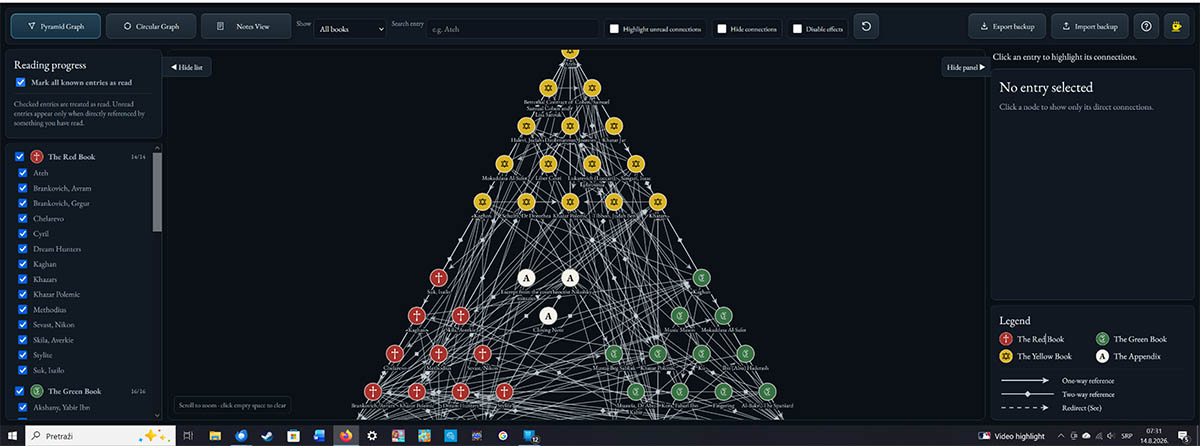
A reader of Dictionary of the Khazars, who says the book was recommended because of their interest in ergodic literature, became so fascinated by its structure that they created a free web application, Dictionary of the Khazars Reading Companion.
The application represents the novel's entries as a network. Readers mark the entries they have completed, while connections between them gradually appear as their reading progresses. The program also allows users to keep notes, import and export them, and export them as a PDF. It was deliberately designed to reveal as little as possible about parts of the book the reader has not yet reached. The project contains no advertising and is non-commercial.
More than four decades after the novel's first publication, a reader has thus created a new digital tool because the very structure of Pavić's book prompted them to search for a new way of reading it.
READERS ON PAVIĆ
Digital reception ultimately belongs to readers. A few of their voices perhaps best illustrate how Pavić's books affect readers today outside the realm of professional literary criticism.
A Goodreads reader writes of Dictionary of the Khazars:
"Every reader must sort it out one's own way."
This is almost an unintended definition of how Dictionary of the Khazars is read.
A reader of Landscape Painted with Tea singles out its structure:
"This novel can indeed be read in the same way that one does a crossword."
A reader of The Inner Side of the Wind begins with the very idea of two sides:
"Love has two sides too – a male side and a female side."
And a reader of Last Love in Constantinople, who had only recently discovered Pavić, writes in Spanish:
"Pavic me encanta, me sorprende, me escandaliza..."
"Pavić delights me, surprises me, scandalizes me..."
She goes on to describe him as a provocateur, a poet and a writer almost impossible to place in a single category.
On Reddit, the tone is even more immediate. In 2026, one reader describes Dictionary of the Khazars as:
"crazy and poetic and cool"
adding that the book is fantastic "in all senses of the word."
PAVIĆ IN THE DIGITAL TWENTY-FIRST CENTURY
Goodreads, Listopia and Reddit reveal three different aspects of the same phenomenon.
Goodreads shows that Pavić is still being read.
Listopia shows where contemporary readers place him within world literature.
Reddit shows what readers do with his books.
And the Dictionary of the Khazars Reading Companion reveals something more: the reader is no longer necessarily only the recipient of a work. Pavić's book can inspire a reader to create a new tool for reading it.
Among new generations, Dictionary of the Khazars therefore appears not only as a celebrated novel published in 1984 or as a work belonging to the history of postmodernism. Readers connect it with concepts belonging to contemporary reading culture: ergodic literature, experimental literature, nonlinear fiction, weird literature, books with innovative structure.
The Internet has not turned it into a literary monument.
Quite the opposite has happened.
Forty-two years after its first publication, Dictionary of the Khazars once again looks like a book made for the way we read in the twenty-first century.
*
DICTIONARY OF THE KHAZARS AS AN INTERACTIVE NETWORK PERFORMANCE — KYIV, 2007
At the Les Kurbas National Centre for Theatre Arts in Kyiv, Anna Aleksandrovich’s project Dictionary of the Khazars, or Requiem for the Theatre (Хозарський словник, або Реквієм за театром), based on Milorad Pavić’s Dictionary of the Khazars, was performed on 7–9 December 2007.
The project was not a conventional theatrical adaptation of the novel, but a combination of theatre, the Internet and interactive audience participation. One of the performances was streamed live through the dedicated website khazary.com.ua. Viewers following the performance online could send comments, while messages from the network communication appeared within the performance space, projected onto the rear wall of the stage. The interaction involved online viewers, members of the audience in the theatre using laptops and mobile phones, as well as the performers themselves.
In this way, the structure of Dictionary of the Khazars — a book without a single compulsory reading order, in which readers establish their own connections between entries — acquired a new media form. The reader became a spectator and an active participant, while the theatrical performance became simultaneously a physical and networked event.
The significance of the experiment is also reflected in the fact that a separate study in Курбасівські читання was devoted to it, entitled “Theatre under the Direction of the ‘Mouse’: From the Experience of Realising the ‘Network’ Project ‘Dictionary of the Khazars, or Requiem for the Theatre’.” The project is also cited in later Ukrainian theatre studies among examples of multimedia and intermedial theatre.
The 2007 Kyiv Dictionary of the Khazars therefore represents an early example of the transfer of Pavić’s poetics from the printed book into an interactive digital environment.